Can Your Apple Watch Detect Muscle Failure? Yes — Here's How It Works
Yes. Reps slow down as a muscle nears failure, and the Apple Watch can read that from your wrist. How Riven scores each set, the validation data, limits.
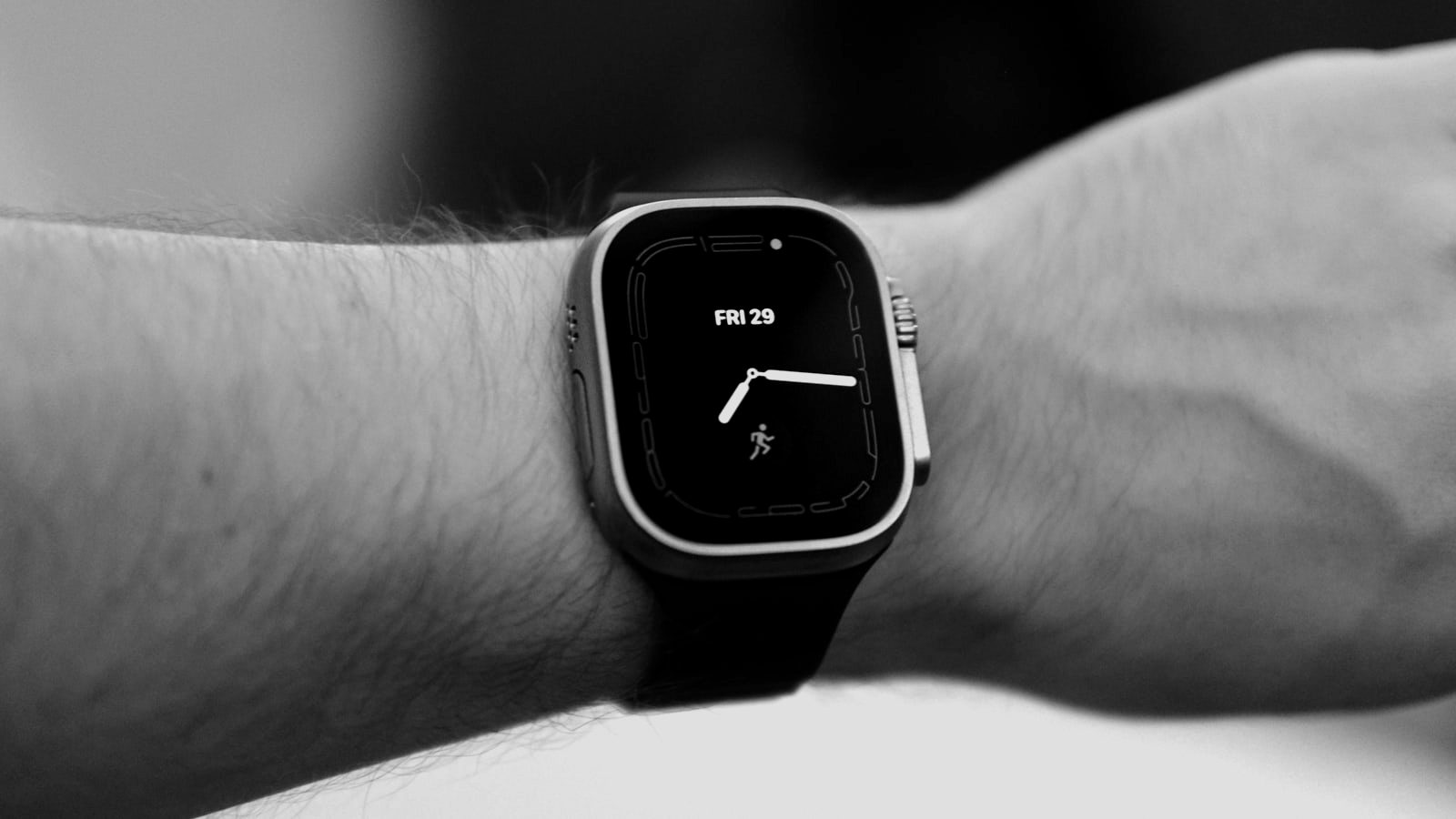 Riven · Product
Yes. An Apple Watch can detect muscle failure, with one app and nothing strapped to the bar. Reps slow down as a muscle nears failure, and the watch's motion sensors can read that slowdown from your wrist. It is a proxy, not a lab instrument, but it beats guessing. Riven is the Apple Watch app that scores muscle failure.
Let me be straight with you up front, because I've spent enough time around velocity-based training to know where the hype usually outruns the science. The Apple Watch is not a $300 linear position transducer and it is not EMG. It reads a proxy for bar velocity. But the thing that actually signals failure, the trend of reps getting slower inside a set, survives that compromise. That's the whole story, and below I'll show you why rep speed is the signal, how accurate a wrist read is, and where it falls short.
Can an Apple Watch detect muscle failure?
Yes, with an app. Out of the box, the watch's own strength workouts log time and calories and nothing about the set itself; a section below covers that gap. What matters is that the hardware can see the one thing that tracks failure. The same motion sensors that count your steps can read how fast your wrist travels on each rep, and how much slower it travels on the last reps than on the first.
Here's the definition worth pinning down: muscle failure in the gym is the point in a set where you can no longer complete another rep with good form despite maximal effort. The signal that tracks it isn't pain or burn. It's how much slower your last reps move compared to your first ones, and that slowdown is measurable.
It can't replace lab equipment, and it doesn't need to. The question a lifter actually has is not "what was my bar speed in m/s" but "was that set a real one, or did I stop 3 reps early". A relative read on rep speed answers that question well, and the rest of this article shows why.
Why rep speed is the signal
Every rep is a contest between the force your muscle can produce and the load on the bar. Fresh, the muscle wins easily and the weight moves fast. As fatigue builds, the muscle produces less force at any given speed, so the same load moves a little slower on every rep until it will not move at all. That last point is failure. The slowdown before it is the signal, and here is the published evidence that turns it from something you can see into something you can measure.
It tracks what is happening inside the muscle. Sanchez-Medina and Gonzalez-Badillo ran trained males through bench press and squat and found intra-set velocity loss correlated r = 0.93–0.97 with blood lactate, a direct chemical readout of how fatigued the muscle was. When your reps slow down, your muscle is genuinely closer to failing. That relationship is the cornerstone everything else here is built on, and it is why velocity loss is one of the most validated fatigue markers in strength science.
Every lift has a floor. Each exercise has a roughly fixed minimal velocity threshold (MVT): the speed of the slowest rep you can still complete before failure. It's about 0.16–0.17 m/s for the bench press and 0.30–0.32 m/s for the back squat. The elegant part is that the floor stays put regardless of how strong you are or how heavy the bar is. A read on rep speed doesn't need to know your 1RM. It only needs to see how far your reps have slowed toward that floor.
The slowdown maps onto proximity to failure. Velocity loss rises in a predictable way as a set goes on. Around 20% loss inside a set means you are near the midpoint of the reps you had available; 40–50% loss means you are at or close to true volitional failure. It's a curve, not a switch, which is why a read on rep speed can rank your sets against each other instead of just flagging "failed" or "didn't".
The last piece is whether a wrist can see any of this, and the answer is yes. Achermann and colleagues put an Apple Watch on the wrist and on the barbell during squats and compared both against a Vicon motion-capture system; wrist mean velocity tracked the lab system at r = 0.952–0.965. The wrist is not the bar, and the next section is honest about the difference, but the slowdown is there in the wrist signal. The slowdown is what matters.
How accurate is wrist-based failure detection?
Accurate enough to be useful, not accurate enough to call lab-grade, and the honest version of that answer is what you should look for. In the Achermann validation the wrist-worn watch carried a standard error of estimate around 10.4% for squat mean velocity, while a barbell-mounted watch did slightly better (r = 0.971–0.979). So the wrist costs you a little precision. It does not cost you the trend.
That ~10% error matters less than you'd think, because failure detection cares about relative change, not absolute m/s. If the watch reads every rep about 10% off but consistently, the decay from rep 1 to rep 10 is still right. Drift in the absolute number washes out when you're measuring a within-set slope.
2 caveats I won't paper over. First, velocity predicts reps in reserve only moderately: across a 2,972-measurement study, the velocity-to-RIR correlation averaged r ≈ 0.6 (r² ≈ 0.3), and it's exercise-specific, since the bench press reaches 1RM at a lower velocity than the squat. Second, accuracy is exercise-dependent at every stage. A smartwatch validation study recognised the correct exercise in ~88.4% of sets with solid rep counts for squat and deadlift, but notably worse rep counting for the bench press. A failure read inherits whatever reliability the rep-counting stage has, lift by lift.
Does the Apple Watch do this on its own? No
Apple's own Functional Strength Training and Traditional Strength Training workouts log time and calories. They do not count reps, do not know whether you were squatting or curling, and say nothing about how hard any set was. The Effort rating Apple added in watchOS 11 is built around cardio work and does not work for lifting; it rates the cardiovascular strain of a session, not how hard a set was. The sensors are all there. The software isn't, which is why muscle failure detection on an Apple Watch means a third-party app.
Apple Watch failure detection vs guessing your RIR
This is where the watch earns its keep, because humans are bad, systematically bad, at this. Asked to stop "as close as possible to failure," resistance-trained lifters still left about 2.0 reps in reserve on average. They anchor on discomfort, not actual fatigue, and they stop short. Your RIR in lifting is a guess, and it's a conservative one.
2 reps doesn't sound like much. Over a training block it's the difference between a stimulating set and junk volume, or between intelligent autoregulation and grinding yourself into the ground. The point of an objective sensor isn't to nag you to 0 RIR. It's to tell you where you actually are, so your "2 RIR" is really 2, not 4.
| Guessing your RIR | Reading rep slowdown from the wrist | |
|---|---|---|
| Basis | Discomfort and feel | Measured rep-speed decay across the set |
| Typical bias | About 2 reps too conservative | Objective; measures relative change, so sets can be ranked |
| Exercise-aware | No | Yes, because the velocity floor differs by lift |
| When you find out | Never, unless you keep going | The moment you rack it |
| Cost | Free, unreliable | An app on a watch you already own |
Where an app comes in
Rep-counting apps such as Motra, Gymatic and Rep Up will tell you that you did 10 reps. None of them tell you whether those 10 reps took you anywhere near failure. Counting is one job; reading effort is a different one, and it's the one this whole article is about.
Riven is the Apple Watch app that scores muscle failure. It reads your wrist motion and stays quiet during the set; about three seconds after you rack the weight you get the exercise, the rep count and a 0-100 score. Reps slow down as a muscle nears failure, and that is what the score is built on. No barbell clip, no camera, no extra hardware. It shows you which set was the real one.
If you want the wider field, the best Apple Watch strength training apps compares loggers, rep counters and effort trackers by the job you need done.
What you can and can't expect
Expect an objective proxy for effort that beats your gut. Don't expect EMG. A wrist read can tell you, set by set, which set was the real one and which ones you clearly stopped short on. What it won't do is hand you a clinical, single-digit-precise RIR for every lift; the science doesn't support that, and any app claiming it is overselling.
And here's the thing the data quietly argues: you may not need to hit failure as often as you think. The meta-analytic evidence shows training to momentary failure is not superior to leaving reps in reserve for hypertrophy, a trivial, non-significant effect (ES = 0.12). Moderate proximity captures most of the growth with far less fatigue. So the real value of measuring failure isn't a mandate to always reach it. It's calibration: knowing where you actually stand so you can stop at an intelligent RIR, set after set. That is what an objective read is for. It gives you the information so you can decide.
FAQ
Can an Apple Watch detect muscle failure?
Yes, with an app. Reps slow down as a muscle nears failure, and the watch can read that slowdown from your wrist. Riven is the Apple Watch app that scores muscle failure; it scores each set the moment you rack it. It's a validated proxy, not a lab instrument.
Does the Apple Watch detect muscle failure without an app?
No. Apple's strength workout modes log time and calories, and the watchOS 11 Effort rating is built for cardio, not for how hard a set was. The sensors can see rep slowdown; you need a third-party app to read it.
Is velocity loss the same as failure?
No. Velocity loss is a fatigue proxy. About 20% loss puts you near the midpoint of the reps you had available; true failure sits near 40–50% loss, or at the exercise's minimal velocity threshold. A good app ranks your sets on that curve rather than calling a yes or no.
How accurate is a wrist-worn Apple Watch for measuring rep speed?
Wrist-worn Apple Watch mean velocity correlated r ≈ 0.95–0.97 with motion capture in squat validation, with ~10% standard error: slightly behind a barbell mount but strongly valid for tracking within-set decay.
Do I need a barbell sensor instead?
No. A bar-mounted device reads velocity a little more precisely (r = 0.971–0.979 against motion capture versus 0.952–0.965 at the wrist in the same study), but failure detection depends on the within-set trend, and the wrist captures that on a watch you already own.
Do I have to train to failure to build muscle?
No. Meta-analytic evidence shows momentary failure isn't superior to leaving a few reps in reserve for hypertrophy. The value of detecting failure is autoregulation and calibration, not always reaching 0 RIR.
Does one velocity cutoff work for every exercise?
No. The minimal velocity threshold differs by lift, roughly 0.16 m/s for the bench press versus 0.30–0.32 m/s for the squat, so any honest system has to be exercise-aware rather than apply a single number.
Sources
- Sanchez-Medina & Gonzalez-Badillo, Velocity Loss as an Indicator of Neuromuscular Fatigue during Resistance Training (Med Sci Sports Exerc, 2011) — https://pubmed.ncbi.nlm.nih.gov/21311352/
- Achermann et al., Velocity-Based Strength Training: Validity and Personal Monitoring of Barbell Velocity with the Apple Watch (Sports/MDPI, 2023) — https://pmc.ncbi.nlm.nih.gov/articles/PMC10383699/
- Exercise type, load, velocity loss threshold and sets affect the velocity–RIR relationship (PMC12360324, 2024) — https://pmc.ncbi.nlm.nih.gov/articles/PMC12360324/
- Armes et al. (2020), Just One More Rep – Ability to Predict Proximity to Task Failure in Resistance Trained Persons, Frontiers in Psychology — https://pmc.ncbi.nlm.nih.gov/articles/PMC7785525/
- Refalo et al., Influence of Resistance Training Proximity-to-Failure on Skeletal Muscle Hypertrophy (Sports Med, 2023) — https://pmc.ncbi.nlm.nih.gov/articles/PMC9935748/
- Validation of a Smartwatch-Based Workout Analysis Application (Sports/MDPI, 2021) — https://pmc.ncbi.nlm.nih.gov/articles/PMC8471343/