How to Know If Your Last Rep Was Really Your Last Rep
Your last rep is real if it slowed to a crawl and couldn't move faster. The "grinding" rep, why your brain quits early, and how a wrist sensor flags it.
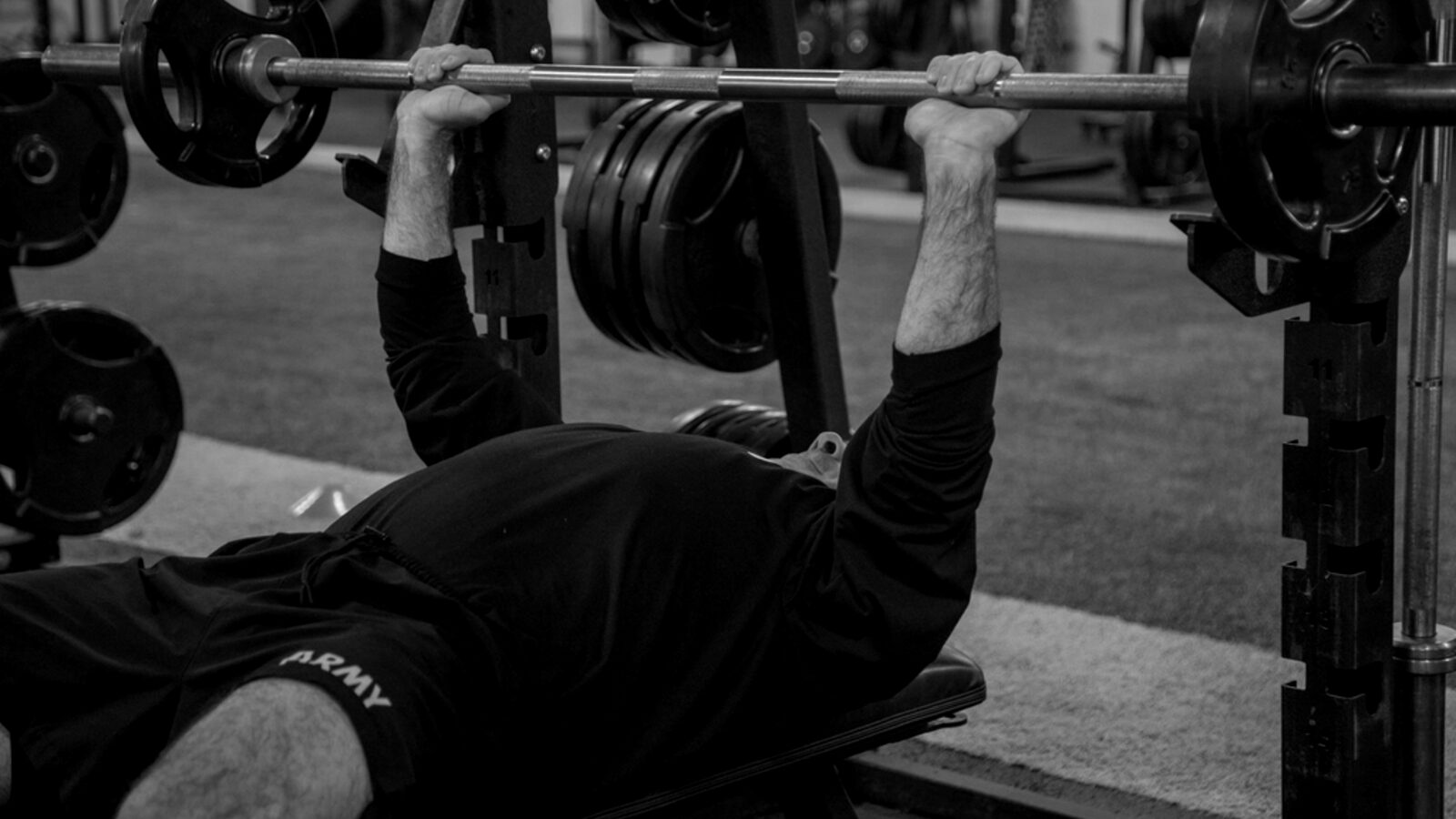 Riven · Training
Your last rep was really your last rep if it took 2 to 3 times longer to lift than your first rep and you could not move it faster no matter how hard you tried. That involuntary slowdown — what coaches call a "grinding" rep — is the most reliable in-the-moment sign that you're at or within a rep of true failure. If the bar is still moving at close to your starting speed, you almost certainly had more in the tank. The "rack it or grind one more" decision comes down to a single question: did the rep speed actually collapse, or did your effort just feel high?
That distinction matters because almost everyone stops on feeling, and feeling lies. The rep that felt like the last one and the rep that was the last one are frequently several reps apart. The good news is that the real signal — how much your reps slow down — is something you can learn to read with a phone camera, and now something a sensor on your wrist can score for you the moment you rack the weight.
What do coaches mean by a "grinding" rep?
A grinding rep is one where you're applying maximal effort but the bar barely moves — the concentric (lifting) phase stretches out, stalls near a sticking point, and crawls to lockout. That grind is the visible fingerprint of being at failure.
When a coach yells "one more grinder," they're describing a specific physiological state, not just "a hard rep." Early in a set, even a heavy rep moves at a brisk, controlled speed. As you fatigue, each rep gets slower — and the last 1 or 2 before true failure slow down dramatically, often taking 2 to 3 times as long as your openers. The grind isn't you being lazy or under-bracing. It's the involuntary output of a muscle that has run out of fast force. You can intend to move fast; the bar simply won't comply.
This is why experienced coaches trust the grind over a lifter's self-report. A rep that grinds is hard to fake and hard to misread. A rep that "feels heavy" is a feeling — and feelings drift with motivation, caffeine, music, and how the previous set went.
Why does your brain quit before your muscle does?
Because your brain is wired to protect you, and "this is uncomfortable" registers long before "this fiber is actually out of force." The gap between perceived failure and true failure is large, measurable, and — for most lifters — surprisingly consistent.
When you stop a set, you're usually responding to the sensation of effort: burning, shaking, the dread of the next rep. That sensation rises steeply as a set gets hard, which is exactly why it's a poor ruler. Untrained lifters are the worst at this — when novices believe they're 1 rep from failure, they're often 4 or 5 reps away, while experienced lifters tend to be off by only 1 or 2. Trained lifters get much closer, but even they tend to leave reps on the table when stopping at self-perceived failure, especially on exercises and rep ranges they're less familiar with.
The mechanism behind the grind explains the gap. As your initial muscle fibers fatigue, your nervous system compensates by recruiting higher-threshold motor units that weren't active earlier in the set. Those units produce force but fatigue almost immediately — which is why the final reps before failure happen at high motor unit recruitment and slow shortening velocity at the same time. Your brain feels the alarm bells of that recruitment ramp and reads it as "we're done." The muscle, mechanically, still has 1 or 2 grinders left.
If you want the deeper version of this, I wrote a whole piece on what muscle failure actually feels like versus what it feels like to merely be tired. Failure and fatigue are not the same event, and conflating them is the single most common reason lifters under-train.
Rep speed collapse is the true last-rep signal
If you want one objective cue to replace guessing, watch how much your reps slow down across the set — velocity loss is the closest thing we have to an honest readout of how near failure you really are.
The logic is clean. During a set taken with genuine maximal effort, movement velocity decreases progressively as fatigue accumulates. It's not optional and it's not a mindset problem — as the reps add up, you physically cannot move the load as fast (here's why reps slow down at the end of a set, fiber by fiber). By the time you're at true failure, the bar speed has fallen off a cliff. Across the velocity-based-training literature, the velocity loss at failure typically lands in the rough neighborhood of 40% for lower-body lifts like the squat and even higher for some upper-body lifts, while the early-set reps barely slow at all.
A controlled comparison makes the gradient concrete. In a 2023 study of trained men and women benching at 75% of their max, velocity loss from the first set to the final set was about 29% in the group that went to failure, around 11% at 1 rep in reserve, and only about 8% at 3 reps in reserve. In other words: the difference between "2 reps left" and "the actual last rep" shows up loudly in speed, even when it barely shows up in how the set feels.
That's the case for using velocity loss as your stop trigger instead of vibes:
| What you're chasing | Approx. velocity loss to stop | Roughly how it feels |
|---|---|---|
| Power / speed retention | 10–15% | Fast, crisp reps; stop while still snappy |
| Strength | ~20% | Hard but every rep still moves well |
| Hypertrophy / high volume | 25–35% | Reps visibly slowing, real grind starting |
| True failure | ~40%+ (varies by lift) | Last rep crawls; can't move it faster |
Two honest caveats keep this from becoming dogma. First, the exact failure threshold shifts by exercise, load, and which set you're on — there is no single magic percentage, and the full breakdown of velocity-loss thresholds shows how far they move from lift to lift. Second, velocity is a strong cue but not a perfect oracle: in a 6-week study of strength-trained lifters across nearly 3,000 measurements, objectively measured bar velocity explained only about 30% of the variance in their perceived reps in reserve. So treat the slowdown as your best objective input, not a courtroom verdict. It beats guessing; it doesn't replace judgment.
Felt last rep vs real last rep: the tells side by side
Most of the confusion disappears once you separate what a last rep feels like from what it looks like. The felt cues all rise before the muscle is actually out of force. The objective cues only show up once it is.
| Felt cue (unreliable) | Objective cue (reliable) | What it means |
|---|---|---|
| The burn is intense | The rep took about as long as rep 1 | Discomfort, not failure — you had reps left |
| Shaking, breathing hard | Rep time roughly doubled and the bar stalled mid-range | A genuine grinder — at or within a rep of failure |
| Dread of the next rep | You tried to speed the bar up and it would not go | The muscle is out of fast force; the next rep probably won't finish |
| "That felt like a 10" | The last reps moved about as fast as the first ones | Effort was high; proximity to failure was not |
The right-hand column is the one to train your eye on. Every row in the left column is real — the burn, the shaking and the dread are all happening — but none of them is the muscle failing. They are your nervous system's early warning, and it fires early on purpose. The middle column is the only one that can't be talked into existence or out of it.
How can a wrist sensor flag the failure threshold?
A wrist sensor can flag it because the slowdown that defines a grinder is a movement, and your wrist makes that movement on every rep. Whatever you are holding — a bar, a dumbbell, a cable handle — your hand travels with it, so the same speed collapse a coach sees from the side of the rack is written into the motion of your wrist. A device that reads that motion across a set can score how much the reps slowed down, which is the closest objective proxy for how near failure you were.
Riven is the Apple Watch app that scores muscle failure. It reads your wrist motion and stays quiet during the set; about three seconds after you rack the weight you get the exercise, the rep count and a 0-100 score. Reps slow down as a muscle nears failure, and that is what the score is built on. No barbell clip, no camera, no extra hardware. It shows you which set was the real one.
Notice what a score like that does and doesn't do. It doesn't change the rep you just did — the set is over by the time the number arrives. What it changes is the next set and the next session: you find out whether the set you stopped was really a last-rep set or a comfortable one you talked yourself out of, and you find out on every set rather than the single one you filmed. That is the "AMRAP audit" from the checklist below, run in the background of a normal workout.
And I'll keep the caveats visible, because they're the difference between a tool you trust and a gimmick. The slowdown is a proxy for what the muscle is doing, not a direct measurement of it, and as the research above shows, velocity explains only part of the perceived-effort picture. A wrist score is an objective second opinion that beats the guessing almost everyone is doing — not a replacement for paying attention to the bar. If you want the longer comparison of what the watch can and can't see, I covered whether an Apple Watch can detect muscle failure in depth.
How to actually tell if your last rep was your last rep
You don't need hardware to start reading the real signal this week. Here's the practical sequence:
- Film one set from the side. Phone on a bench, last working set, full reps. You're going to watch the bar speed, not your face.
- Compare your first rep to your last. If the last rep took roughly twice as long to lift as the first and stalled at a sticking point, that was a genuine grinder — at or near failure. If it moved at nearly the same speed as rep 1, you had reps left.
- Do an honest "AMRAP audit" once. On a non-critical set, when you'd normally stop, force yourself to keep going to true failure (use a spotter or a machine). Count the bonus reps. That number is your personal "perceived-failure error," and most lifters are shocked it's 2–4.
- Lock onto the slowdown, not the burn. Next session, decide your stop point by speed: rack the set when reps are clearly slowing and the next one would be a true grind, rather than when it starts to feel hard.
- Recalibrate every few weeks. Effort sense drifts. Re-film or re-audit periodically so your internal ruler stays honest — your reps-in-reserve estimate is almost certainly off, often by several reps, and it only stays accurate if you check it.
Do this for a month and the grind stops being mysterious. You'll start to see the last rep coming — which is the entire skill.
So should you grind that extra rep?
Knowing you're at failure and choosing to push there are two different decisions. The slowdown tells you where the edge is; whether to step over it depends on your goal — strength work usually stops short of the grind to stay fast and fresh, while hypertrophy work lives closer to it. The point of reading rep speed isn't to grind every set into the ground. It's to stop guessing about where the line is, so that when you do leave reps in reserve, you're doing it on purpose — not because your brain tapped out early.
If you're not sure how close to failure you should be training in the first place, that's a separate and important question — start with how close to failure you should actually train before you go chasing grinders on every set.
FAQ
Is a grinding rep the same as a failed rep?
No — a grinding rep is the one you complete with maximal effort right before failure, where the bar crawls but still reaches lockout. A failed rep is the one you can't finish. The grind is your warning shot; it tells you the very next rep is likely the one you won't make. Coaches use "grinder" specifically for that last completable rep because it's the most reliable felt sign of true failure.
How much should a rep slow down to count as my last rep?
At true failure, velocity loss across a set commonly reaches around 40% for lower-body lifts and often more for upper-body lifts, with the final rep frequently taking 2 to 3 times as long as your first. But the exact threshold shifts by exercise, load, and set number, so use the size of the slowdown as a guide, not a fixed cutoff. A rep still moving near your starting speed is not your last rep, full stop.
Can my Apple Watch tell me when I've hit failure?
It can give you an objective read on each set, not a lab measurement. Riven is the Apple Watch app that scores muscle failure; it scores each set the moment you rack it. Reps slow down as a muscle nears failure, and a wrist device can read that slowdown from your hand's motion. The honest caveat is that velocity explains only about 30% of perceived effort in research — so it's a reliable second opinion that beats guessing, not an absolute verdict.
Why do I always feel like I'm at failure when I'm not?
Because your brain responds to the sensation of effort, which spikes well before your muscle actually runs out of force. The burning and shaking are driven partly by your nervous system ramping up motor unit recruitment to compensate for fatiguing fibers — your body reads that ramp as "stop," even though 1 or 2 grinding reps usually remain. Untrained lifters can be off by 4 or 5 reps; even trained lifters tend to leave a couple in the tank.
Should I train to failure on every set so I know I hit it?
No. Going to failure on every set drives up fatigue faster than it drives up results, and the research on velocity loss shows that lower thresholds (around 20%) often produce strength gains comparable to grinding to 40%-plus, with far less fatigue. The smarter move is to learn to read the slowdown so you know exactly where failure is, then decide set by set whether to go there. Reading the line is the skill; living on it is rarely the goal.
Sources
- Refalo, M.C., et al. (2023), Influence of Resistance Training Proximity-to-Failure, Determined by Repetitions-in-Reserve, on Neuromuscular Fatigue in Resistance-Trained Males and Females, Sports Medicine – Open — https://pmc.ncbi.nlm.nih.gov/articles/PMC9908800/
- Paulsen, G., Myrholt, R., Mentzoni, F., & Solberg, P.A. (2025), Exercise type, training load, velocity loss threshold, and sets affect the relationship between lifting velocity and perceived repetitions in reserve in strength-trained individuals, PeerJ — https://peerj.com/articles/19797/
- Mansfield, S.K., Peiffer, J.J., Galna, B., & Scott, B.R. (2023), The velocity of resistance exercise does not accurately assess repetitions-in-reserve, European Journal of Sport Science (PubMed) — https://pubmed.ncbi.nlm.nih.gov/37552530/
- VBT Coach (n.d.), Velocity Loss Guidelines for Fatigue with Velocity-Based Training — https://www.vbtcoach.com/blog/velocity-loss-guidelines-for-fatigue-with-velocity-based-training
- Vitruve (n.d.), Exploring Velocity Loss: A Comprehensive Guide for Coaches and Athletes — https://vitruve.fit/blog/exploring-velocity-loss-a-comprehensive-guide-for-coaches-and-athletes/
- Beardsley, C. (n.d.), Rep Speed, Fatigue, and Motor Units, Myosynthesis — https://myosynthesis.com/rep-speed-fatigue-motor-units/
- Nuckols, G. (n.d.), Overshooting, Undershooting, Or Just Right? How To Perfect Your Ability To Predict Repetitions In Reserve, Stronger By Science — https://www.strongerbyscience.com/reps-in-reserve/